


Volume 98, October 31, 2026


I recently bought an electric guitar to give me something to do besides stare at the computer or play more bad golf. I started by trying to learn the opening riff from Smoke on the Water by Deep Purple, which reminded me of a fond memory.
About twenty years ago, I was sitting in a carrier meeting with Ford in Detroit. We’d been warned to turn off our cell phones or face a fine, with the proceeds going to charity.
As it happened, my father was having surgery that day, and I wanted to be available in case something went wrong. So I left my phone on, loud ringer and all.
About ten minutes into the meeting, my phone rang.
Every head in the room turned toward me. I got up and hurried into the hallway to answer it, expecting news about my father.
Instead, I heard my teenage son’s excited voice.
“Hey, Dad! Listen to this!”
And with that, he proceeded to play the opening riff from Smoke on the Water on my guitar back home.
Ford fined me, of course.

THE SLIPPERY SLOPE
“If socialists understood economics, they wouldn’t be socialists.”
— Attributed to economist Friedrich Hayek
The midterm election is just a few days away, and given the quagmire that is American politics and the media, who knows what will happen?
History suggests Republicans will lose seats in the House, the Senate, or both. After all, the president’s party almost invariably suffers losses in midterm elections, and President Trump happens to identify as a Republican, if in name only. But that’s a rant for another day.
Consider Democrat Franklin Roosevelt. In 1936, he won one of the largest landslides in presidential history. Two years later, Democrats lost 72 House seats and seven Senate seats. This from a man who won four presidential elections in a row.
Every election is heralded as the “most crucial in American history” by a media seemingly devoid of a social conscience. This year, though, they may be right. Even a stopped clock is right twice a day.
This year…,
GUEST COMMENTARY
The Midterms May Decide What Kind of Country We Leave Behind

by Chris Sorensen
I believe the upcoming midterm elections may be among the most consequential of my lifetime. I have watched America experience wars, recessions, cultural upheaval, political scandals and periods of deep division. Through it all, I have continued to believe in the basic strength of our constitutional republic. Today, however, I am genuinely concerned about what kind of country my children and grandchildren will inherit.
My concern is not simply that one political party may win more congressional seats than another. Elections come and go. My concern is that America appears to be approaching a fundamental choice between two very different visions of government, freedom and personal responsibility.
The progressive wing of the Democratic Party continues moving toward policies that place more authority in the hands of the federal government. These policies are frequently presented under reassuring labels such as fairness, equity and economic justice. Yet behind those words are proposals for greater government control, more spending, heavier regulation and increased dependence on federal programs.
Supporters…


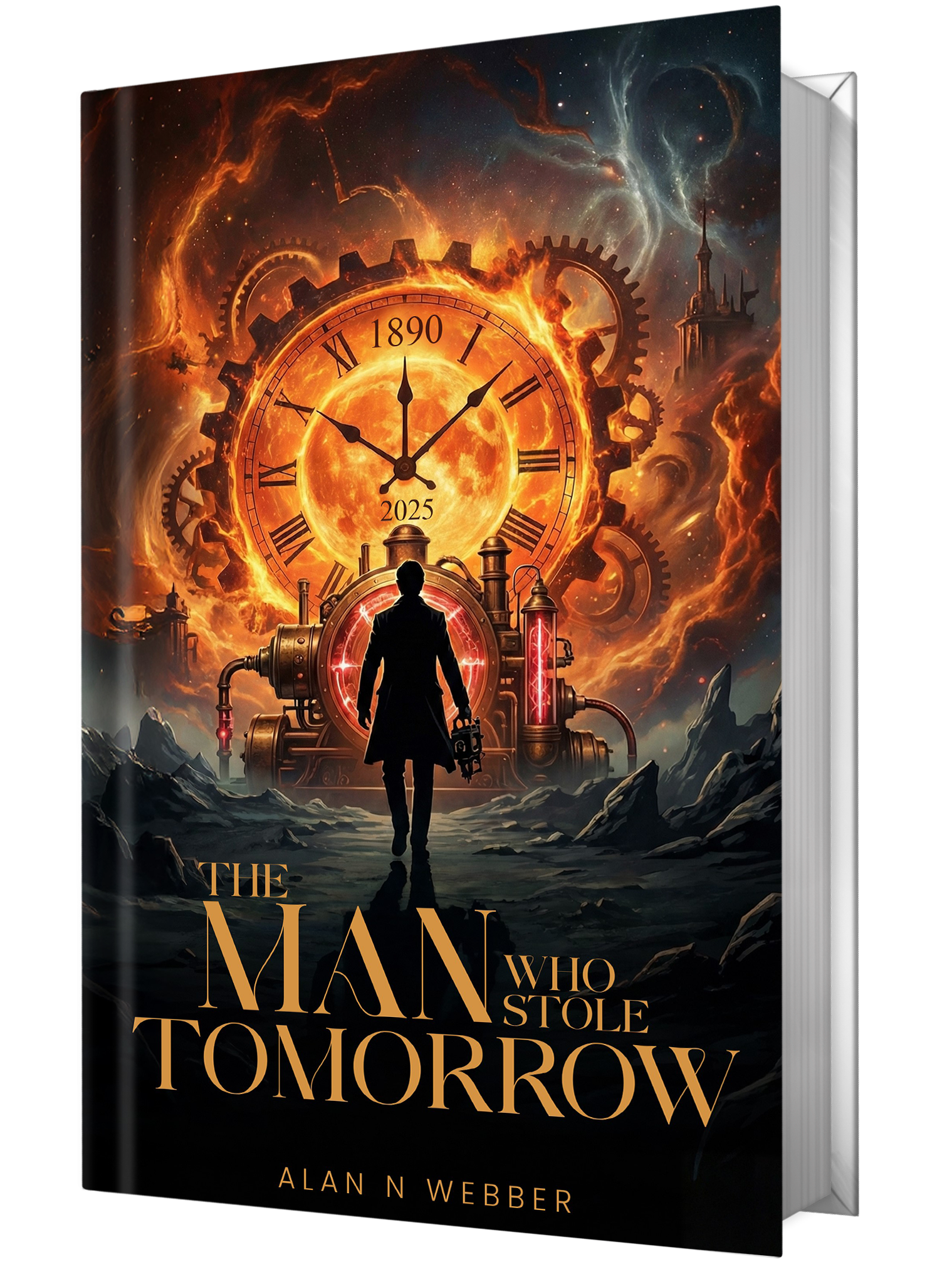
In 1895, H. G. Wells published his classic, The Time Machine. But what if the famous journey wasn’t the first?
In The Man Who Stole Tomorrow, author Alan Webber imagines that Wells’s time traveler conducted a secret test run five years earlier, with potentially disastrous consequences. It was a journey that nearly cost him his life and threatened to prevent the adventure that would become a literary classic.
A new twist on one of science fiction’s greatest stories.
Author’s Note - The Man Who Stole Tomorrow was accepted into the collection of the H. G. Wells Museum in London, England.

Ok, I know there are not that many Packer fans in my mailing list, but something truly remarkable happened Thursday night in the Packers win over the Carolina Panthers in Green Bay WI.
In the second quarter of the game he was sandwiched between two Carolina defenders that resulted in him getting an ambulance ride to the local hospital. An hour later he returned to Lambeau Field in an ambulance, walked out of the field, and resumed playing. Watch here:

‘39 by Queen
This beautiful ballad by Queen is perhaps their finest song, although it’s one that many people aren’t familiar with. Guitarist and Queen co-founder Brian May handles both the vocals and guitar work impeccably.
Widely regarded as a virtuoso musician and one of the greatest guitarists of all time, May ranks 33rd on Rolling Stone’s list of the 250 greatest guitarists and is a member of the Rock & Roll Hall of Fame.
But Brian May is much more than just a long-haired hippie with a guitar. In fact, he is quite an extraordinary individual.
In 2007, he earned a PhD in astrophysics from Imperial College London. He served as Chancellor of Liverpool John Moores University from 2008 to 2013 and collaborated with NASA’s New Horizons mission to Pluto. He’s also a co-founder of Asteroid Day, a campaign dedicated to raising awareness about asteroids and planetary defense. In recognition of his scientific contributions, asteroid 52665 Brianmay was named in his honor.
In 2023, May contributed to NASA’s OSIRIS-REx mission, which successfully returned samples from the asteroid Bennu to Earth. That same year, King Charles III knighted him for his services to music and charity.

© 2026 Black Mountain – Independent Publishing
All rights reserved.
Opinions expressed are those of the respective authors and guest contributors and do not necessarily reflect those of the publisher. Brief quotations may be used with attribution.